A View from Early-Career Researcher Cecilia Avorkliyah
(University of Media Arts and Communication and Institute of African Studies, University of Ghana)
As a television lecturer at the University of Media Arts and Communication (UniMAC) and a PhD candidate at the Institute of African Studies, University of Ghana, I had the privilege of participating in the IAMHIST conference on Decentering Media Histories and Practices. The biennial conference, my first, was held from 30th June to 2nd July, 2025, at the University of Cape Town’s Graduate School of Business conference centre near the Victoria & Alfred Waterfront. For me, it was more than a time of personal development, networking, and fresh purpose. My PhD thesis focuses on Female Characterisation and film aesthetics, with a special emphasis on post-colonial filmmakers from Africa. The IAMHIST conference provided me with new insights into how we recall, depict, and recreate African media practices, in addition to allowing me to engage in critical discussions about media, radio and film in Africa.

Conference Buddies: Cecilia Avorkliyah, from the University of Media Arts and Communication (UniMAC), Ghana, with Tina Louise-Smith, from the Centre for Film and Media Studies, University of Cape Town, at this year’s IAMHIST conference, held in Cape Town, South Africa.
The opening keynote, delivered by Professor Sekibakiba Lekgoathi from the University of the Witwatersrand, was a remarkable highlight to kick off the conference. His presentation on Radio Freedom, Sonic Archives, African Solidarity, and the Liberation Struggle in South Africa was both impactful and informative. While my research and professional focus is on film and television, Lekgoathi’s presentation on the role of radio as a means of resistance during apartheid provided profound historical insights that truly resonated with me. The most striking aspect was Lekgoathi’s use of audio samples from Radio Freedom, allowing us to listen to the voices that once inspired a liberation movement. I discovered that tuning into these broadcasts was not just rebellious but also subject to punishment, yet individuals still embraced the risk. This brought to mind that the media is never impartial; it is always intertwined with power dynamics and conflict. The discovery that Zambia broadcast a feed to South Africa during this period emphasised cross-border solidarity, introducing an additional dimension of historical and geopolitical intricacy that made a significant impact.
The conference brought together a global group of film scholars, emerging researchers, persons working in media archives and fellow PhD students from around the world. A three-day event, the conference was organised with four parallel sessions occurring at the same time each day, facilitating smooth transitions between panels. This created a dilemma for me in selecting which session to attend, while also allowing me to connect with a variety of topics, perspectives, and fields.
One of the most significant sessions I attended was the Early Career Researcher Workshop, held by IAMHIST council members Llewella Chapman and Tobias Hochscherf, and the editors of the Historical Journal of Film, Radio and Television James Fenwick and Veronica Johnson, which focused on enhancing writing skills for blogs, book reviews and journal articles. The workshop, which clarified the peer review process, was especially beneficial for me as a lecturer from the University of Media Arts and Communications. This facilitators revealed new publishing avenues, such as The Journal of Popular Television, where I could share insights from my teaching and research practice. They also emphasised the importance of writing clearly and confidently, and encouraged viewing peer review as a dialogue instead of a barrier. The session completely transformed my view on academic publishing from a challenging obligation to an approachable, cooperative endeavour that adds significantly enriches our practice and field.
In another session, David Stein’s presentation, “Seeing Ourselves: The Current Status of Audiovisual Restitution in South Africa”, raised questions about ownership, access and representation in international media archives. Archives, he underlined, are by no means passive or neutral repositories. Instead, institutions in positions of power curate and shape them and this has a significant impact on which stories are saved and how they are presented.
Stein made several vital arguments, one of which was that we must first comprehend what was taken and what has been lost before we can discuss reparation. His presentation highlighted the contradiction that, although specific South African audiovisual resources, such as historical films, are available in these foreign archives, accessing them is often hindered by gatekeeping procedures, stringent regulations, and bureaucratic barriers.
The main lesson I learnt from Lekgoathi’s and Stein’s presentations was that, unless critically questioned, media archives tend to mirror prevailing views. What is included shapes them just as much as what is left out. Remixing, reframing, and refusing to remain silent are all integral to decolonial media practice and histories, as emphasised by the clear call to action embedded in the presentations of these scholars. Without a doubt, this concept will shape my research and understanding of media archives and memory.
Another highlight was the plenary panel session titled “Colonial Reels and the PanAfrican Archive: Critical Disruptions of Archives of Empire” with panel members Imruh Bakari, Emma Sandon, Jihan EI-Tahri, June Givanni, Samantha Iwowo and Jacqueline Maingard, lead investigator of the Colonial Reels project. An exciting aspect of the conference was the opportunity to interact with luminaries whose work I have long appreciated. Meeting legendary scholars, curators and filmmakers like Bakari, Givanni, and El-Tahri felt like a complete circle experience. These are the individuals whose writings and creative works have defined the very landscape of African cinema; they have significantly influenced my academic career.
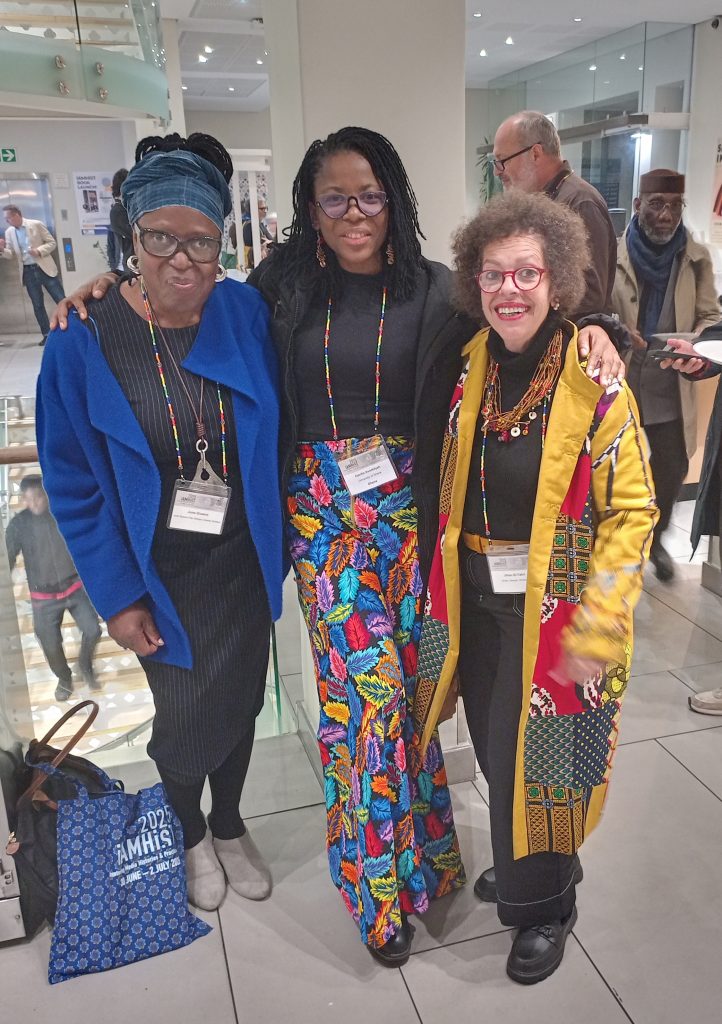
Cecilia Avorkliyah with pioneering film curator June Givanni of the June Givanni Pan African Cinema Archive, and acclaimed Egyptian-French filmmaker Jihan EI-Tahri.

Cecilia Avorkliyah with filmmaker and writer Imruh Bakari, of the Colonial Reels Project.
In informal interactions, I discussed my thesis on female characterisation in African cinema. The response I received was positive and, more importantly, constructive. One significant idea was to supplement my textual analysis with semiotic analysis, a method for uncovering the deeper meanings behind visual and narrative structures in the selected films under study.
Aside from the academic material, what made this conference genuinely remarkable was the relationships I formed. I met fellow PhD candidate Tina-Louise Smith (UCT), whose research complements mine; she eventually became my “conference buddy” for the duration of the event. I equally interacted with postdoctoral scholars interested in collaboration, and older academics eager to advise and encourage. There was an overall sense of learning, sharing, and growing together.
The experience reminded me that academic work, particularly in the field of African media and cultural studies, is not a solitary endeavour. It is a dynamic and collaborative effort to reimagine our past, question dominant narratives, and chart new paths forward. It was encouraging to know that others are asking similar issues and encountering similar challenges, and that there is room for all of our perspectives when it comes to decentering media histories and practices.
It would be impossible for me to describe my conference experience without mentioning the elegant dinner, held at Sevruga restaurant at the Victoria & Alfred Waterfront on the evening of the second day. This event provided a friendly setting that allowed me to interact and hold meaningful conversations with scholars I had not had the opportunity to engage with during the official sessions. Beyond the beautiful surroundings and delicious food, the evening proved to be a priceless networking opportunity, ultimately enhancing the overall conference experience.
Attending this conference was not only a professional highlight but also a profoundly personal affirmation of the work I do and the path I have chosen. I departed with a greater sense of assurance in my academic voice, a greater capacity to participate in scholarly discourse, and a greater dedication to the critical reinterpretation of African media histories.
I highly recommend fellow film scholars, students, early-career researchers, and all those working in the fields of radio, film, and media to participate in future IAMHIST editions. The conference for me was more than presenting paper; its conversations help to shape the future of our disciplines by challenging us to rethink how and what we archive, teach, and create. The conference topic is essential to understanding our identity and the content of our media archives in order to think, write, and instruct effectively in the contemporary era.
I am inspired by the opportunities that await me as I continue my PhD path. As a scholar-practitioner, the ideas generated at this conference will influence not only my thesis but also my writing, teaching, and media engagement. I am excited to stay in touch with the academics I met, explore potential joint papers, and contribute to discussions around decentering media histories and practices.
IAMHIST 2025 served as a reminder that, despite the differences in our unique initiatives, we all share the same objective: to diversify, decolonise, and decenter the media histories and practices that have all too frequently obscured or misrepresented our past.
About the author
Cecilia Avorkliyah is a PhD Candidate at the Institute of African Studies at the University of Ghana. Her research focuses on Female Characterisation and Film Aesthetics in West African cinema. Cecilia’s research is broadly focused on gender, film, and Television. Cecilia is a Queen Elizabeth Scholar and has been a Visiting Research Fellow at HUMA – Institute for Humanities in Africa at the University of Cape Town. She holds an MA in Global Development and Social Justice from St. John’s University, New York, and a Post Graduate Diploma from the University of Education, Ghana. She is a lecturer at the University of Media Arts and Communication, where she teaches Television Production. Cecilia is an experienced filmmaker who has directed TV programs and documentary films. Her latest documentary, titled ‘The Loud Silence‘, addresses the silence surrounding domestic violence in Ghana.
Disclaimer
The IAMHIST Blog is a platform that offers individual scholars the opportunity to present their work and thoughts. They alone are responsible for the content, which does not represent the view of the IAMHIST council or other IAMHIST members.